Welcome to the December 1910 Centenary Blog

This blog is designed to report on events, activities and material from history, culture and the arts, relating to the December 1910 Centenary Conference at the University of Glasgow on 10-12 December 2010. The conference is being organised by the Scottish Network for Modernist Studies and the British Association of Modernist Studies. Over 100 speakers will be travelling to Glasgow from all over the UK and the rest of the world to deliver papers from across many disciplines responding to Virginia Woolf's famous statement that 'on or about December 1910, human character changed. To find out more about the conference or register to attend, visit the main conference website here. Or you can now follow us on Twitter as SNoMS1910!

Monday, 29 November 2010

'Glasgow Girls': Artists and Designers in the Early Twentieth Century

Margery Palmer McCulloch (University of Glasgow) writes:

The major ‘Glasgow Boys’ exhibition recently moved from the Kelvingrove Art Galleries in Glasgow to the Royal Academy in London, receiving broad (and in some places, mixed) attention in the press. But another exhibition currently on show at Glasgow’s School of Art reminds us that we should not forget the ‘Glasgow Girls’.

Designed by Charles Rennie Mackintosh in the last years of the nineteenth century, the modernist School of Art opened in two stages in 1899 and 1909. Under its enterprising director Francis (‘Fra’) Newbery, it was also the catalyst for the avant-garde ‘Glasgow Style’ in the early years of the new century. Significant female Glasgow artists of this period included the Macdonald sisters, Margaret and Frances, who exhibited with (and respectively married) Charles Rennie Mackintosh and Herbert MacNair in European exhibitions such as the Vienna Secession in 1900 and the International Exhibition of Modern Decorative Art in Turin in 1902. Both sisters challenged traditional representations of women with their elongated female images in water-colour paintings and embroidered panels. (Their detractors described this as the ‘Spook School’.) Margaret also exhibited widely on her own and in association with MacNair, and her work was featured in the principal European art magazines of the time such as The Studio, Deutsche Kunst und Dekoration and Dekorative Kunst.
Margaret Macdonald Mackintosh, Cover of 'Deutsche Kunst und Dekoration', May 1902, 1902.
© The Hunterian, University of Glasgow 2010.
Another successful designer and illustrator was Jessie M. King who exhibited in Turin and Berlin, as well as in Ireland and India. In 1910 (the object of Woolf’s famous remarks) she went to Paris with her husband where they established a private art school. King was influenced in Paris by the designers of the Ballets Russes and brought their vivid use of colour into her own work.

Strong painters among this group of women artists included Nora Neilson Gray who went to France during the war as a volunteer nurse with the French Red Cross. Gray worked after her night shifts, producing chalk drawings of soldiers and striking oil portraits such as ‘The Belgian Refugee’ (1916) and a group portrait of the nurses and soldiers in the reception space for the injured in the medieval cloisters of the Abbaye de Royaumont where she was stationed.

The Silk Dress c. 1918, Eleanor Allen Moore, self-portrait, oil on canvas, 
private collection
Other women specialised in female subjects, but painted their sitters with a female as opposed to a male ‘gaze’, as in Eleanor Anne Moore’s exotically dressed but sceptically-eyed woman in ‘The Silk Dress’. At the turn of the century, Bessie MacNicol exhibited in Glasgow, London, Liverpool and Manchester as well as in Munich, Vienna, Dusseldorf, St Petersburg, Venice and regularly in the USA between 1896 and 1901, but death in childbirth put an end to her career in 1904.

These talented women helped put ‘Glasgow Style’ on the international map, but they were neglected by art historians who traditionally focused on male artists such as the ‘Glasgow Boys’ and the ‘Scottish Colourists’ who were influenced by European post-Impressionism. They were neglected, that is, until American art historian, Jude Burkhauser’s seminal exhibition, ‘Glasgow Girls’: Women in Art and Design 1880-1920 was shown to much acclaim and huge audiences at Kelvingrove in 1990 during Glasgow’s year as European City of Culture. The accompanying catalogue, published by Canongate (and still available), is full of biographical and bibliographical research material, essays, photographs of the artists themselves and their Glasgow School of Art environment and, most importantly, illustrations of paintings, ceramics, fabric and other design work. Its influence has been phenomenal in establishing the ‘Glasgow Girls’ within our understanding of the visual arts and their importance in the early twentieth-century history of the city.

In ‘Beyond the Reaches of Feminist Criticism’, Shari Benstock argues that if we were to ‘dig deep enough’ among the ruins of the Panthéon, that ‘burial place for distinguished men’, then we would find there the forgotten women of literary modernism. Burkhauer’s exhibition precisely achieves this act of recovery. So the Glasgow School of Art’s decision to host a smaller version at the present moment should be met with enthusiasm. Although a small exhibition cannot display the larger art works that made such an impression in 1990, the current showing opens an important window onto the contribution to modernism in the visual arts made by the women of Britain’s ‘Second City of the Empire’ around the time that ‘human character changed’.

Monday, 22 November 2010

Diaghilev in Glasgow

Professor Graham Watt writes:

On this Friday 26 November it will be 82 years to the day since the Ballet Russes began a six day stint at the Kings Theatre in Glasgow. This was the company's only appearance in Scotland, apart from a similar visit to the King's Theatre in Edinburgh a week later. Jane Pritchard, curator of the current Diaghilev exhibition at the Victoria and Albert Museum in London,* provides an excellent list of their performances between 1922 and the death of Diaghilev in 1929 in a long article in Dance Research: in November and December of 1928, the company undertook a five week tour of UK cities, performing in Manchester (Opera House), Birmingham (Prince of Wales), Glasgow (Kings), Edinburgh (King's) and Liverpool (Empire), before a Christmas and New Year engagement in Paris (Theatre de l'Opera).


Kings Theatre, Glasgow

The six Glasgow performances, including a Saturday matinee, took place at the Kings Theatre in Bath Street between 26th November and 1st December, 1928. They were fronted by Sir Thomas Beecham who conducted the orchestra and acted as a public voice for the company on its provincial tour. Eight ballets were performed in varying combinations of three or four: Le Tricorne, The Gods go a-begging, Aurora's Wedding, Cimarosiana, La Chatte, Prince Igor, La Boutique Fantastique and Les Sylphides.

These Glasgow performances by the Ballet Russes were advertised in the Herald newspaper on every day on which the company performed. Although there were no feature articles or photographs, this coverage included two reviews by the newspaper's music critic:

There was a great audience to welcome the Russian Ballet at the Kings Theatre last evening when they made their first appearance in Glasgow. It is a great venture to bring so large a company of famous dancers and a large and capable orchestra to the city and the great success of the opening performance encourages the hope that the week's visit will justify the venture and that other visits will follow.

Compared with Continental peoples, we do not know very much in this country about opera, and we know even less of ballet dancing as a fine art. Russia for two generations has been the foremost exponent of this art. The ballet is taken more seriously there than anywhere else and the fine work that has been seen in London so often and was presented in Glasgow for the first time last night is the result of a long and higly specialised education. The provinces are fortunate in having the opportunity of seeing what the ballet at its highest can be and the experience will arise in some spectators and strengthen in others a feeling of discontent with the limtations that attach to our theatrical system.

There follows comments on each of the ballets featured on the first night. Apart from Massine's choreography none of the company are mentioned by name. The reviewer concludes:

The stage always offers something that holds the eye and it is at the same time as eloquent as it is graceful. And the beauty of the dancing is matched by the beauty of the final pose in each incidental event with groupings and decor as enhancements of the picture.

Despite the reviewer's hopes, this was the first and last performance by the Ballet Russes in Glasgow, and the English regions. Witin a year, Diaghilev had died in Venice, of septicaemia following furunculosis, due to diabetes mellitus (penicillin had been discovered only a year earlier and was not yet in general use). Diaghilev's company folded, but in 20 years he had not only transferred classical ballet from Russia to the western world (including what would become the Royal Ballet); he also revolutionised the repertoire and ignited a host of related careers, including those of Massine, Balanchine, Fokine, Larionov, Nijinska, Bakst, Benois, Goncharova,  Picasso, Cocteau, Stravinsky, Prokofiev, Satie and Chanel.

When King Alfonso of Spain teased Diaghilev, "What is it then that you do in this troupe? You don't dance. You don't direct. You don't play the piano. What is it that you do?" Diaghilev replied, "Your majesty, I am like you. I don't work. I don't do anything, but I am indispensable".

*The V&A maintain an excellent, ongoing blog dedicated to aspects of this exhibition.

Monday, 15 November 2010

The Death of Lev Nikolayevich

Darya Protopopova (University of Oxford) writes about the centenary of Leo Tolstoy’s Death (20 November 1910 – 20 November 2010)

On the eve of the centenary of Tolstoy’s death the Russian TV channel Culture will be showing a four-part documentary ‘In Search of Tolstoy’, directed by Alexander Krivonos. The first part explores Tolstoy’s war experience, first in the Caucasus and then, during the Crimean War, in Sebastopol. It searches for the roots of Tolstoy’s pacifist philosophy in his first-hand impressions of death on the battlefield. The second part looks at Tolstoy’s complicated relationship with his wife Sofya Andreyevna. The third part tells the story of Tolstoy’s daughter Alexandra who fulfilled her father's wishes by turning his estate into a museum. Alexandra Tolstoy was arrested several times by the Soviet government, but in 1929 she managed to emigrate, first to Japan, and then to the USA, where she founded the Tolstoy Foundation, active to this day. The last part of the documentary contains a somewhat ossifying message. According to the channel’s website: ‘Tolstoy’s philosophical quest will always be cherished by the progressive mankind’. Out of all people across the world who have dedicated their lives to studying and promoting Tolstoy’s works, the creators of the documentary have chosen to talk about a certain Alexander Shevchenko, an 82-year-old industrial worker from the Crimea who propagandises Tolstoy’s teachings on the streets of Sebastopol. They obviously wanted to demonstrate that Tolstoy, like Lenin from a famous Soviet slogan, ‘lived, is alive, and will live’ in the hearts of simple Russian people. Tolstoy’s works, especially his novels, are indeed still loved by the common Russian reader. But does his ‘quest’ resonate in the hearts of modern Russian politicians?

According to Miriam Elder, Fyokla Tolstaya, a great-great-granddaughter of the writer, said in a recent interview:

Lev Nikolayevich [Tolstoy] posed very uncomfortable questions. The problems he wrote about — militarism and pacifism, justice, religion, the Caucasus — none of them have been solved.

‘He is a very difficult author for today’s leadership,’ she added in the same interview. Tolstoy’s nonconformist views may be the reason behind the lack of official ceremonies commemorating the writer’s death in his homeland. But the absence of government-organised tributes is probably for the better: Tolstoy himself hated public homage. Alexander Goldenveizer remembered how Tolstoy said, with reference to the addresses and congratulations on his eightieth birthday (28 August 1908):

I believe I am right in saying that I have no vanity, but I can’t help being touched involuntarily. And yet, at my age, I live so far away from all this, it is all so unnecessary and so humiliating. Only one thing is necessary, the inner life of the spirit. (Trans. by Samuel Koteliansky and Virginia Woolf)

In a diary entry for 7 September 1908, Sofya Andreevna Tolstaya gives a detailed account of her mixed feelings about the ‘so called Tolstoy’s eightieth jubilee’, through which, to use her words, the family had to ‘survive’. Tolstoy received around 2,000 congratulatory telegrams, along with presents, from his admirers. But some ‘presents’ showed that he remained a controversial figure even amidst this universal approbation. A mother who probably had lost her son during the revolutionary turmoil in Russia at the time, sent a box with a hanging rope and a note wishing Tolstoy to die. Tolstoy preached peace, but his ideas of equality were often misused or misinterpreted by Russian radicals.
Tolstoy's deathbed - from Smert' Tolstogo (Moscow, 1929)
So perhaps it is best in the end that in Russia the commemoration of Tolstoy’s death at Astapovo railway station is restricted to TV documentaries and an opening of the Tolstoy Educational and Tourist Centre in Lipetsk, the administrative centre of the area to which Astapovo belongs. The railway station itself will be at the heart of the commemoration. The death that it witnessed on 20 November 1910 was not a tranquil event and certainly did not lack in publicity. Tolstoy’s ‘escape’ from his estate, his sudden illness at Astapovo, his wife’s futile attempts to see her husband, who was being guarded by his daughter and close friends including Vladimir Chertkov – these famous aspects of Tolstoy’s last days make up a dramatic and, in a way, sordid story, which was reported daily by international newspapers. The Times, for instance, published fifteen articles dedicated to Tolstoy between 14 November and 26 December 1910, covering Tolstoy’s death, funeral arrangements, and proving of the will.

While Tolstoy was lying on his deathbed, Astapovo was surrounded by a whole camp of prying people: journalists, devotees, and simply curious. They stayed in tents, warmed themselves around fires, and kept vigil under the station’s windows. They also sent and received numerous telegrams from Astapovo, over a thousand in total, which in 1929 were collected in a book titled The Death of Tolstoy (Smert’ Tolstogo), published by the Russian (then Soviet) National Library.

This collection of telegrams constitutes a valuable and moving source for today’s reader. Around 5.50 am on 20 November telegrams started flying from Astapovo to the rest of the world, containing two words, ‘Tolstoy skonchalsya’ (‘Tolstoy has passed away’). Two hours later journalists started telegraphing more detailed accounts of Tolstoy’s death. By that time it had become known that the writer’s last words were: ‘There are many people in this world, and you are worrying about one Lev [the Russian version of Tolstoy’s name]’. Telegrams were also flying from the outside world back to Astapovo: in one night the station received 8,000 words of condolence.

An interesting telegram was sent by a correspondent of the Russian newspaper The Morning of Russia. It reports that a few hours after Tolstoy’s death the sun was shining brightly and the station started attracting ‘pilgrims’ from nearby villages and towns. People were coming in big numbers to venerate Tolstoy’s body. Among crowds of agitated peasants the legend was born that Tolstoy did not die, but is only asleep, like miraculous saints of the past. Other journalists were using this legend figuratively, asking their newspapers to announce that although Tolstoy died in Astapovo, his spirit lives on in all Russia and the rest of the world, ‘for where love is, death does not exist’.

Tolstoy’s body being carried outside the Astapovo station - from Smert' Tolstogo
To me, the most touching evidence of Tolstoy’s life after his death is the story of the writer’s posthumous portrait by Leonid Pasternak. Pasternak, who admired Tolstoy greatly and painted numerous portraits of him during the writer’s life, arrived at Astapovo a few hours after the tragic news. With him he brought his twenty-year-old son Boris, at the time a philosophy student at the Moscow University. Thirty-five years later Boris Pasternak started working on his novel Doctor Zhivago, which can be described as the War and Peace of the twentieth century. The epic novel tracing personal biographies against a vast historical background, Doctor Zhivago undoubtedly continues the Tolstoyan tradition of fiction-writing. And the symbol of this for me is an image of the young Pasternak at Tolstoy’s deathbed.

Wednesday, 10 November 2010

On or about Diaghilev and the Ballet Russes


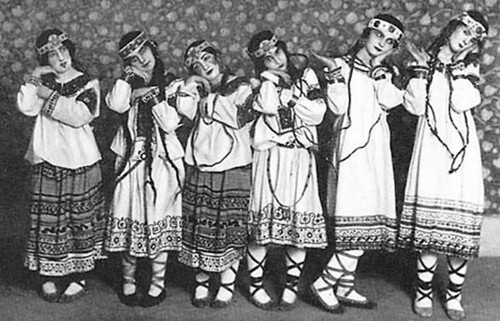
As defining moments go, 29 May 1913 is more famous in the history of the Ballets Russes than December 1910. That was the date of the first performance of Igor Stravinsky's Rite of Spring at the Théâtre du Champs-Elysée in Paris; and it was an occasion that saw riots amongst the first audience, requiring police intervention.

le Sacre du Printemps - 1913
Critics are divided as to whether the audience was upset most by the polytonal asymmetrical rhythms of Stravinsky's music, by the Fauvist costumes and set designs of Nicholas Roerich, by the unorthodox choreography devised by the Ballet Russes star dancer Vaslav Nijinsky (dancers shuffled on with pigeon-toed movements), or by the subject matter of the ballet itself: a young pagan girl is chosen by her tribe as a sacrifice and dances herself to death, to the orgiastic accompaniment of Stravinsky's rhythmic chords.

The BBC's recent drama, 'Riot at the Rite' neatly captures the aura of controversy surrounding the Rite, from the personal tensions between the artists involved to the behaviour of the audience.


It also rightly identifies the central role of Sergei Diaghilev, the director of the Ballet Russes. Diaghilev is an unusual figure in the history of ballet: after a failed attempt to become a composer, he made a name for himself in Russia, through editing an avant-garde arts magazine, Mir iskusstva, but came to prominence in the West through a series of art exhibitions, promoting Russian painting in Paris during the early years of the Twentieth Century.

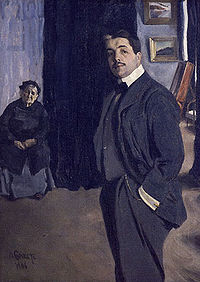
Diaghilev, by Léon Bakst (1906)
Diaghilev's career is currently the subject of an exhibition at the Victoria and Albert Museum in London ('Diaghilev and the Golden Age of the Ballets Russes 1909-1929'), which makes it very clear that his strengths did not lie in artistic creation. Instead, Diaghilev had the ability to spot provocatively modern talents, such as Stravinsky and Nijinsky, bring them together and, by dint of his personality (and his person - he was Nijinsky's lover for five years) keep them together for the period of their collaboration. Given the precarious condition of his finances, this was no mean skill.

Ballet, even more so than other theatrical art forms, is supremely collaborative. It depends on the combined talents of choreographers, dancers, musicians, designers and composers for the creation of spectacle. The V&A conveys this through the sheer variety of media on display in the exhibition: dancing shoes, costumes and musical scores vie with video projections of archive performances and the rooms are dotted with small booths playing an excellent series of informative films by Howard Goodall about the musical background to Diaghilev's ballets. In fact, the only problem with the exhibition is that there is so much multimedia on display that it is sometimes difficult to make out what Goodall is saying over the sound of Stravinsky's Firebird in another part of the room.

Stravinsky in 1910
In terms of collaboration, though, perhaps Virginia Woolf's choice of 1910 does have a claim upon our attention. For it was in 1910 that Stravinsky first started working on his score for the Rite of Spring. But, there is some uncertainty here. As Sjeng Scheijen points out in a recent biography of Diaghilev, Stravinsky and his artistic collaborator Nicholas Roerich couldn't agree on who first came up with the idea. What's more Schejen describes an earlier production, The Pavillion d'Armide in 1907 as marking ‘a new era in the ballet culture of St Petersburg’ and Diaghilev’s first major success in bringing together avant-garde choreography and dance (in this case, Nijinsky and Michel Fokine).

It may, then, be a mug's game to try and pin down particular transformative moments in cultural history, but the first performance of the Rite of Spring certainly made a commotion. Diaghilev’s response? ‘Exactly what I wanted’.

Sunday, 31 October 2010

Guerres imaginaires

Mark West (University of Glasgow) considers the literature of invasion:

On the 19 March 1906, the Daily Mail began the serialization of William Tuffnell Le Queux's The Invasion of 1910, an "invasion-fantasy" in which Germany invades Britain. Its enormous popularity was no doubt helped by a marketing strategy that included sending actors in German military uniforms to march down London's Regent Street. It sold over a million copies and was translated into 27 languages. One marker of its success was a film version entitled If England Were Invaded, released in October 1914.
From, I.F. Clarke, 'Future-War Fiction',
Science Fiction 24:3 (1997)

The book couches events as a military history, incorporating excerpts from journals and military descriptions of troop movements. Convinced that Britain was in constant threat of invasion by the Germans, Le Queux stresses the importance of preparation and training and devises a British resistance called the "League of Defenders" who manage to incite an uprising against the invading hordes.


The phenomenal success of The Invasion of 1910 testifies to the popularity of what I.F. Clarke calls “Future-War Fiction”, in the wake of the Paris Commune in 1871 and Germany’s unification. Writers across Britain, France and Germany imagined variations on “The Next Great War”, “der nächste Krieg”, and “La Guerre de demain”. H.G. Wells would go as far, in The World Set Free (1914), as to imagine a bomb so massive in its destructive capabilities that its use as a deterrent would lead to a new era of peace on earth.

Clarke suggests that the tone of this "massive European interest” in the next great was was a "cheerful language of anticipation", a language by no means limited to the military minds that first wrote such stories. Is it, then, a great leap between such popular fictions and the martial language of early Modernists, such as F.M. Marinetti and his gang of Futurists?
The Futurist Manifesto
in Le Figaro 20 February 1909
In his “Futurist Manifesto” of 1909, Marinetti describes how "like young lions we ran after Death". Singing "the love of danger", they "glorify war – the world's only hygiene – militarism, patriotism, the destructive gesture". These are "beautiful ideas worth dying for", lit by "the vibrant nightly fervor of arsenals and shipyards blazing with violent electric moons".
If, as Virginia Woolf asserted, 1910 ushers in a new mode of human character, it was long in the making; and wide in its reach, too. Change of this kind embraces not merely the artistic consciousnesses of those that went to the Grafton Galleries in the last months of the year. These future-war tales and fantasies suggest a longing for change. There is a desperate desire in these “fantasies of the future” for what Clarke calls a “newer universe”. Of course, as we know now, the realisation of such a desire would have a terrible “human” cost.

Tuesday, 19 October 2010

"And so you are going abroad..." T.S. Eliot in 1910

1910 was the year that T.S. Eliot graduated from his first degree at Harvard; it was the year he published his first poem ('Humoresque: After Jules Laforgue'); and it was the year he travelled to Paris to hear Henri Bergson lecture.
According to some, Eliot's sojourn in Paris was life-changing. Lodging at 151 bis rue St Jacques, Eliot took French lessons from Alain Fournier (author of Le Grand Mealnes) and befriended a fellow-lodger, Jean Verdenal. In The Making of an American Poet, James E. Miller speculates that this friendship with Verdenal constitutes the first great gay love of Eliot's life - and his first great loss: Eliot marked Verdenal's death in World War I by dedicating Prufrock and Other Observations to his memory.
Charles-Louis Philippe
Miller suggests that Verdenal is a strong presence in The Waste Land too, one that lies behind the figure of Phlebas the Phoenician. A memory of Verdenal informs the vision of the lilac girl in 'The Burial of the Dead', he argues; and, more tenuously, he suggests that a boat trip to St Cloud with Verdenal lies behind the 'Damyata' section of the 'What the thunder said'.
There are more convincing, material influences upon Eliot to be traced from this period too. It seems that Verdenal introduced him to l'Action Français - Charles Maurras' right-wing movement, an influence upon Eliot in the 1930s; and Fournier introduced to Jacques Rivière, secretary to La Nouvelle Revue Française (established in 1909) and an associated group of writers, including André Gide. In turn, it is likely that Gide's tribute to Charles-Louis Philippe in November 1910 helped to introduce Eliot to Philippe's work, particularly Bubu de Montparnasse, which strongly influenced the urban landscapes of Eliot's early published poetry.
(c) Houghton Library
It's striking that Eliot should turn to another written source to make sense of Paris. Biographical speculations aside, it's certain that this period saw significant developments in his poetry. According to Christopher Ricks' edition of his poetic notebooks (Inventions of the March Hare), it was during Eliot's stay in Paris that fragmentary scraps of verse began to cohere into 'The Lovesong of J. Alfred Prufrock' (a discarded passage, 'Prufrock's Pervigilium' shows the heavy influence of Philippe) and in November 1910, Eliot composed the first section of 'Portrait of a Lady' (a poem that closes with the narrator's departure for Europe). In other words, this is the period in which Eliot starts to shrug off his reliance upon Laforgue and write his earliest and most striking mature verse.

Wednesday, 13 October 2010

A Century, a Lifetime and a Comet

Celebrating the appearance of Halley's Comet in April 1910, Tom Coles (University of Glasgow) ponders comets and periodisation:


"I came in with Halley's comet in 1835. It is coming again next year, and I expect to go out with it. It will be the greatest disappointment of my life if I don't go out with Halley's comet. The Almighty has said, no doubt: 'Now here are these two unaccountable freaks; they came in together, they must go out  together.' Oh! I am looking forward to that." 
Albert Bigelow Paine, Mark  Twain, A Biography,
Ch. 282 ‘Personal Memoranda

Halley’s Comet means almost as much to me as it did to Mark Twain: I was born in early 1986, around the time when it last appeared, and in 2061 when it next approaches close to Earth I suppose I will not be too sad, like Twain, if I leave with it. As a period of study, the 75 years that the comet takes to return is curious, perhaps more useful than the equally arbitrary 'century'. A century tends to be the default time-frame of the rise of empires, the dominance of an art-form, the epoch of a revolution. It has become the primary frame through which we view history, even if we often have to make it ‘long’ and ‘short’. The century is always followed by another century; it is a method of linear chronology that invites concepts of procession or improvement.

We risk fetishizing a unit of time of our own making. In contrast, a comet offers an image of the same object returning unimproved, unadorned, for its own reasons - but measurably. The problem is that one hundred years in any direction is that it is just out of reach. It exists as a social rather than a personal memory. A hundred years is simply a hundred years: within it much can happen while little changes, or much can change with little happening. The world a hundred years ahead or behind is an older or younger peer. The orbital period of Halley’s comet, a single transit of a lump of rock, ice and gases around the sun is, on the other hand, a lifetime. It seems longer, somehow, than a century.

Tycho and Kepler were able to place the comets beyond the moon; to make further roads out of a geocentric totalised world-view; to chalk one up for rationalism. They participate in what Gabriel Josopovici has described in his recent Whatever Happened to Modernism?  as part of a “powerful myth, that of the Renaissance as the triumph of the individual after centuries of subservience to authority and tradition… of light coming out of darkness and the myth of the emancipation of the individual…” (p.11). How does the symbol of this comet, which Halley proved to be engaged in an almost eternal return, fit in with a procession of knowledge unwinding its secrets? If there is no permanent triumph, but only return, how do we create a narrative of our own and others' lives within history?

This contradiction, that the scientific universe is guided by stronger and more rigid rules than those of any social or cultural system that previously claimed to govern our worlds, is what Schiller calls the disenchantment of the world: it is the difficulty that we have when our problems are too satisfactorily explained. Explained in so rigorous a fashion their very rationalism, meeting our needs perfectly, becomes a sort of magic in itself. Knowing that Halley was coming back in 1910 didn’t stop people from claiming that it threatened cataclysm – its very predictability seemed terrifying. The millennial feeling is perhaps the overburdening of what we know to be an arbitrary date. It is simply another day, but because it is ‘simply another day’ how could it possibly survive the weight of expectation we have placed upon it?

Josipovici suggests that to argue over the ‘beginnings’ (and endings) of Modernism as occurring at one date or another, is short-sighted: instead we should be looking at what in the past is still present for us, where we still live in the same space. Rather than looking for what has left or arrived on a certain date, it may be better to look for what came back.

Mark Twain did, after all, die the day after the comet’s appearance, as he promised, on the 21st April 1910. He was seventy-five. His autobiography, which has been under a publication ban, is to be published in November 2010, one hundred years (and a few months) after his death, as, for his own reasons, he insisted.